TPUs vs. GPUs: The Race for Efficiency
We are living in the era of massive models. From GPT-4 to Gemini, the race to train trillion-parameter networks has exposed a critical bottleneck in modern computing: efficiency. For decades, general-purpose processors (CPUs and GPUs) have powered the digital world by being flexible enough to do anything. But when it comes to the highly predictable, math-heavy world of deep learning, 'flexible' often means 'inefficient.' To keep up with the exponential growth of AI, we didn’t just need faster chips—we needed a fundamentally different architecture. Enter the Tensor Processing Unit (TPU).

What Is a Tensor Processing Unit (TPU)?
A Tensor Processing Unit (TPU) is a domain-specific application-specific integrated circuit (ASIC) designed specifically to accelerate machine learning workloads.
Unlike general-purpose processors that must support a wide range of tasks, TPUs are optimized for the tensor and matrix operations that form the computational core of modern neural networks. This specialization allows TPUs to execute machine learning computations with high throughput and predictable performance, while significantly reducing unnecessary control and scheduling overhead.
Tensor Processing Units were first introduced by Google in 2016 with TPU v1, primarily focused on accelerating inference workloads in production systems.
By tightly integrating with machine learning frameworks and compiler-based execution models, TPUs are designed to efficiently support both training and inference at scale.
TPU Architecture
The architecture of a Tensor Processing Unit is shaped by the design goal of efficient matrix-centric computation at scale. Rather than relying on flexible instruction scheduling like CPUs or GPUs, TPUs adopt a dataflow execution model that maximizes data reuse and predictable throughput.
TPU Chip and TensorCores:
At the hardware level, each TPU chip contains one or more TensorCores, which are the fundamental computing elements. A TensorCore consists of multiple processing units including:
A Matrix Multiply Unit (MXU), implemented as a systolic array, optimized for large matrix multiplications
A vector unit for operations such as activation functions or softmax
A scalar unit for control flow and address calculations
The MXU’s systolic array connects thousands of multiply-accumulate units in a grid-like structure, where data flows rhythmically across processing elements.
Systolic Arrays and Data Movement:
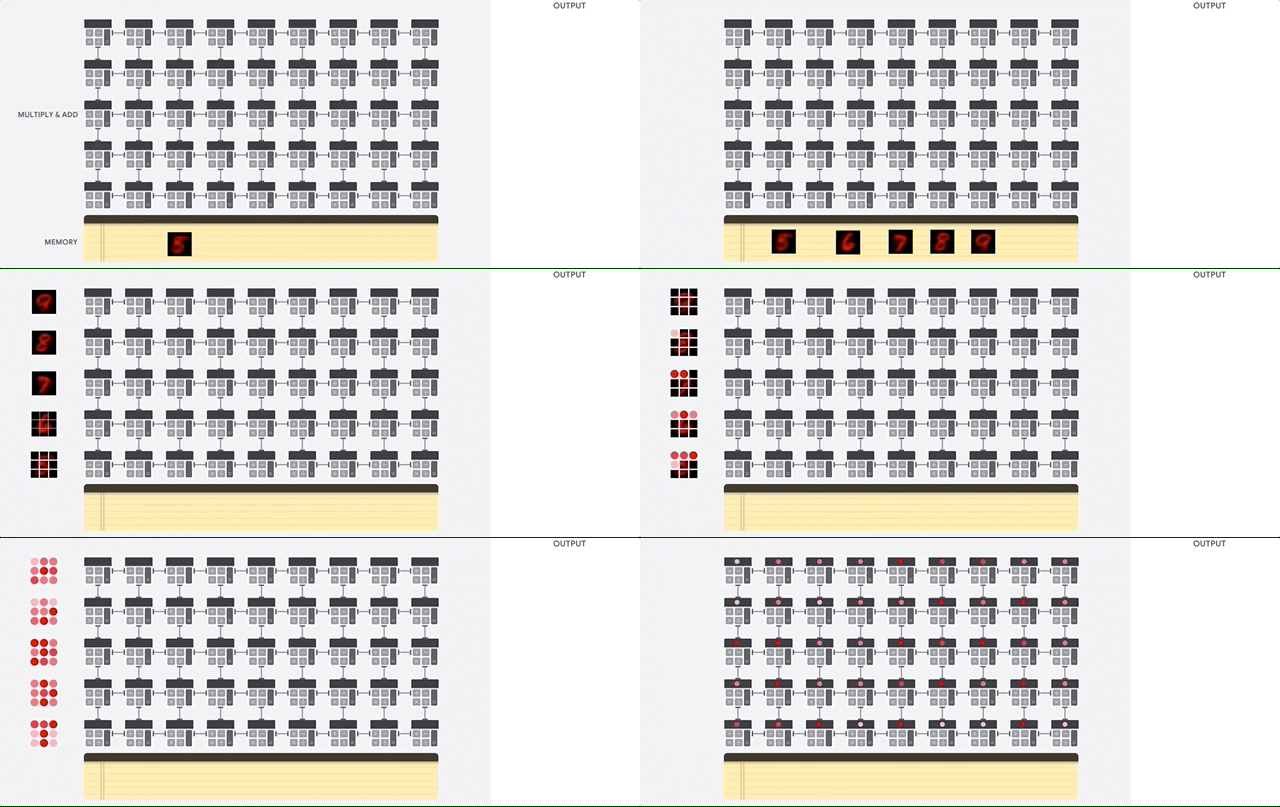

A defining feature of TPU architecture is the use of systolic arrays for matrix multiplication.
Instead of repeatedly fetching data from off-chip memory, data flows through a grid of processing elements where partial results are accumulated locally. This dataflow execution model minimizes external memory traffic, which is often more expensive than computation itself, enabling higher efficiency and improved performance-per-watt for dense linear algebra workloads.
Memory and Data Locality:
TPUs are designed to emphasize data locality and reduce costly memory transfers. By keeping frequently used data close to the compute units using on-chip buffers and high-bandwidth memory (HBM), TPUs limit reliance on off-chip memory access.
System-Level Organization: Slices, Pods, and Topology:
Beyond individual chips, TPUs are organized into larger computing structures for scalable workloads:
Slice: A group of chips connected via high-speed inter-chip interconnect (ICI) within a TPU Pod. Slices define how many chips work together for a single job.
TPU Pod: A contiguous collection of TPU chips that work together over a specialized network to scale training or inference workloads
Depending on the version, these slices and pods can vary in size, but the key idea is that TPUs are not just standalone chips; they are parts of a distributed compute fabric designed for large models.
How CPUs, GPUs, and TPUs Work
To understand why specialized accelerators like TPUs matter, it helps to first grasp how CPUs and GPUs operate and where they fit in the computing stack.
CPU: Flexibility over Throughput:
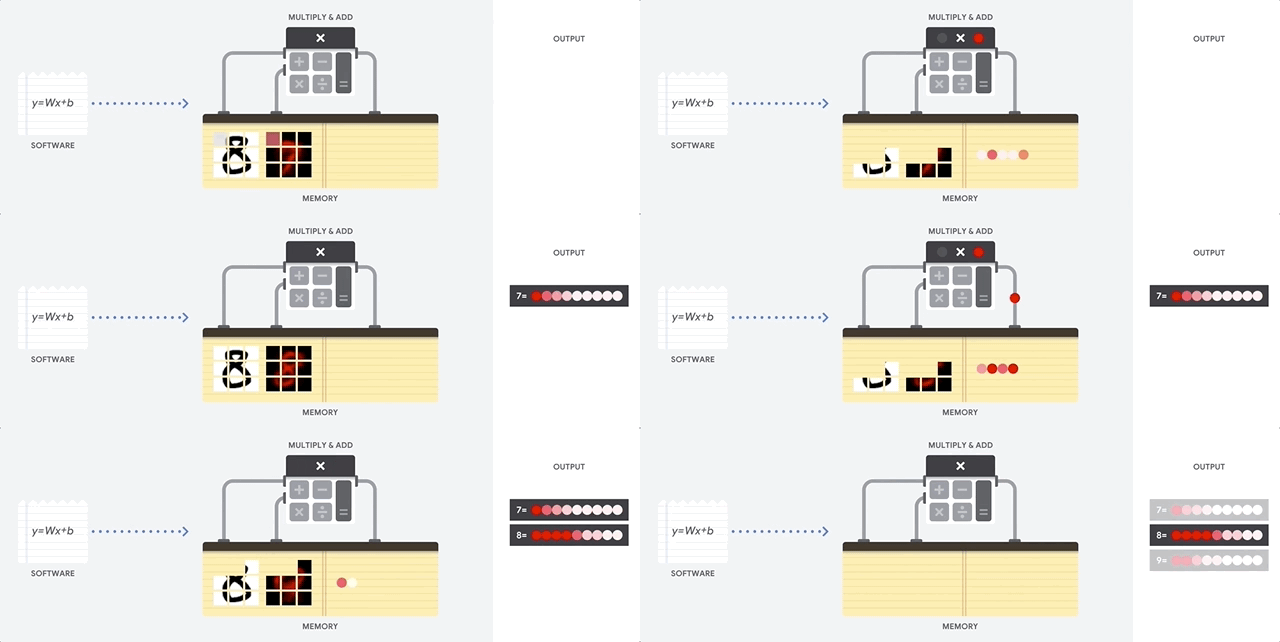
A CPU is a general-purpose processor based on the von Neumann architecture. For every computation, the CPU loads data from memory, performs the calculation, and writes the result back to memory.
While this design offers extreme flexibility, it introduces a fundamental limitation: memory access is significantly slower than computation. This “von Neumann bottleneck” restricts throughput for compute-intensive workloads such as machine learning
GPU: Massive Parallelism with General-Purpose Constraints:
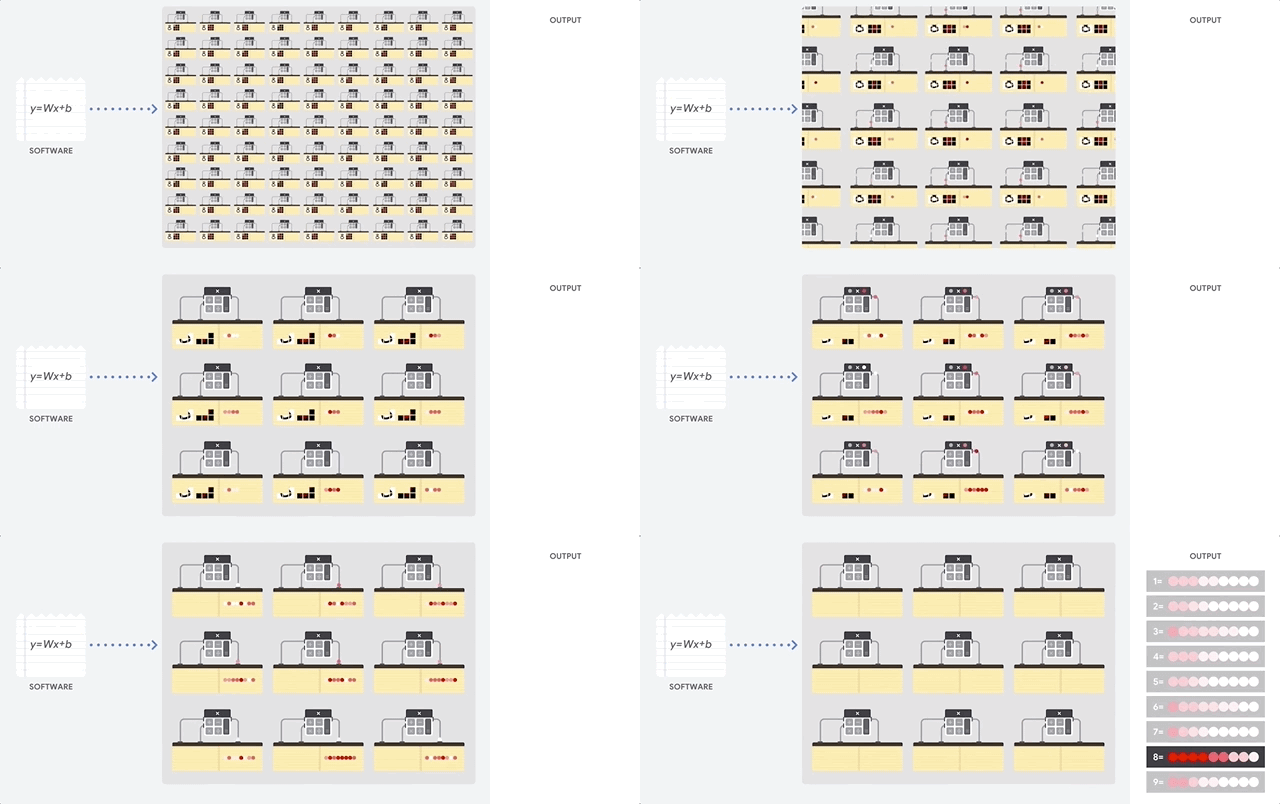
To improve throughput, GPUs use thousands of arithmetic logic units (ALUs) to perform computations in parallel. This makes them well-suited for highly parallel workloads like matrix operations.
However, GPUs remain general-purpose accelerators. Each ALU still relies on frequent access to registers or shared memory for operands. At scale, this repeated data movement and control overhead becomes a limiting factor for efficiency and power consumption.
TPU: Matrix-Centric, Dataflow Architecture:
TPUs are designed as matrix processors specialized for neural network workloads. They focus almost exclusively on multiply — accumulate operations.
In this architecture, model parameters are loaded into the Matrix Multiply Unit (MXU). Once computation begins, data flows through the systolic array without requiring intermediate memory accesses. By eliminating repeated memory reads/writes, TPUs achieve very high computational throughput.
GPU Limitations at Scale
GPUs, particularly those developed by NVIDIA, have been the backbone of modern machine learning. However, at large scale, GPUs face inherent limitations stemming from their general-purpose design.
A key challenge is data movement. Even with high-bandwidth memory, GPUs repeatedly transfer intermediate data between compute units and memory, making memory traffic a dominant cost in both performance and power consumption.
The rise of domain-specific accelerators like TPUs introduces competitive pressure. By prioritizing performance-per-watt and hardware–software co-design, TPUs highlight the limits of general-purpose architectures when scaling machine learning systems.
Why TPUs: Functions, Advantages, Limitations & Constraints
At a high level, TPUs support the two core functions of modern ML:
Large-scale training
High-throughput inference
The contrast between TPU-trained Gemini models and GPU-based models highlights the impact of hardware specialization. TPU-based dataflow architectures stream tensor operations directly through large systolic arrays, minimizing intermediate memory traffic.
However, these benefits come with constraints:
Specialization: TPUs are less suitable for non-ML or irregular workloads.
Flexibility: Performance depends heavily on compiler-optimized execution graphs (XLA).
Ecosystem: Tight integration with Google’s cloud ecosystem introduces platform dependency.
Conclusion
TPUs illustrate how hardware specialization is becoming essential to scaling machine learning systems efficiently. As models continue to grow, understanding these architectural trade-offs is increasingly important for building performant and sustainable ML infrastructure.